
This week, former head of the Presidential Office Andriy Yermak was declared suspicious and taken into custody, the Russians launched one of the longest attacks on Ukraine since the end of the "ceasefire", and the Ukrainian military responded with a massive strike on Moscow and the Moscow region.
Babel has compiled the main events of the week so that you can stay up to date with the news.
Yermakʼs suspicion
On the evening of May 11, NABU and SAPO reported suspicions to the former head of OP Andriy Yermak. According to the investigation, he is a participant in a scheme to legalize UAH 460 million for the construction of the “Dynastia” cooperative in Kozyn near Kyiv. The financing of the project could partly have come from corruption schemes at “Energoatom”, which are being investigated as part of the “Midas” case.
Six more people were also suspected in this case, including former Deputy Prime Minister of Ukraine Oleksiy Chernyshov and businessman Tymur Mindich.
The court considered the motion to impose a preventive measure on Yermak for two days — May 12 and 13 — due to the large amount of materials and interruptions due to the air raid siren. On May 14, the Supreme Court of Ukraine sent Yermak to custody for two months with the option of a bail of UAH 140 million.
On the evening of May 15, Yermakʼs lawyer Ihor Fomin reported that all UAH 140 million of bail had already been collected for the former head of OP.
However, he remained in pre-trial detention for the weekend, as he failed to deposit the entire amount into the bank on Friday evening. Among the largest "donors" was the former coach of the national football team Serhiy Rebrov.
Cartel
On Friday, May 15, a new prisoner exchange took place between Russia and Ukraine. 205 Ukrainian soldiers returned home. This is the first stage of a planned 1 000-for-1 000 exchange, which Ukraine agreed to with US mediation.
Most of the released Ukrainian soldiers had been in Russian captivity since 2022. They defended Ukraine in Mariupol and at “Azovstal”, in the Donetsk, Luhansk, Kharkiv, Kherson, Zaporizhzhia, Sumy, Kyiv directions, and the Chornobyl nuclear power plant.
In addition to soldiers and sergeants, more than fifty officers were able to return home. The youngest discharged soldier was 21 years old, the oldest was 62 years old.


Massive shelling of Ukraine
On the afternoon of May 13 and the night of May 14, the Russians carried out one of the longest massive air attacks against Ukraine. In particular, they launched 800 drones during the day, and 56 missiles and 675 drones at night.
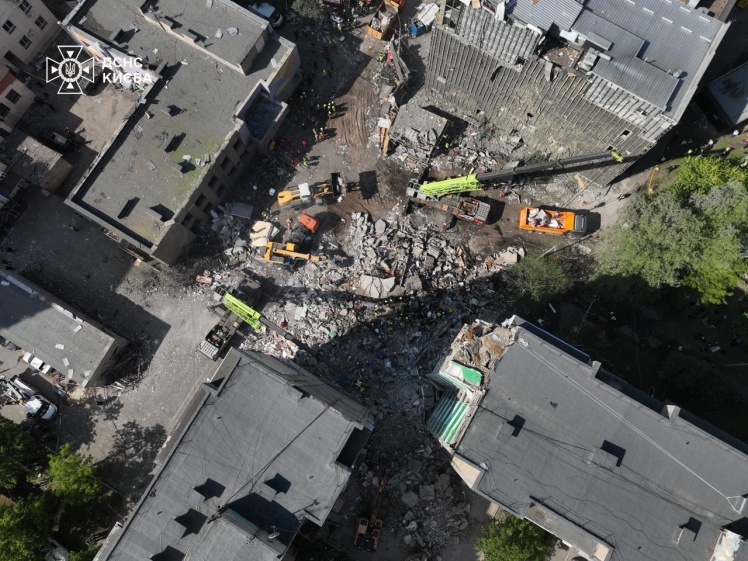
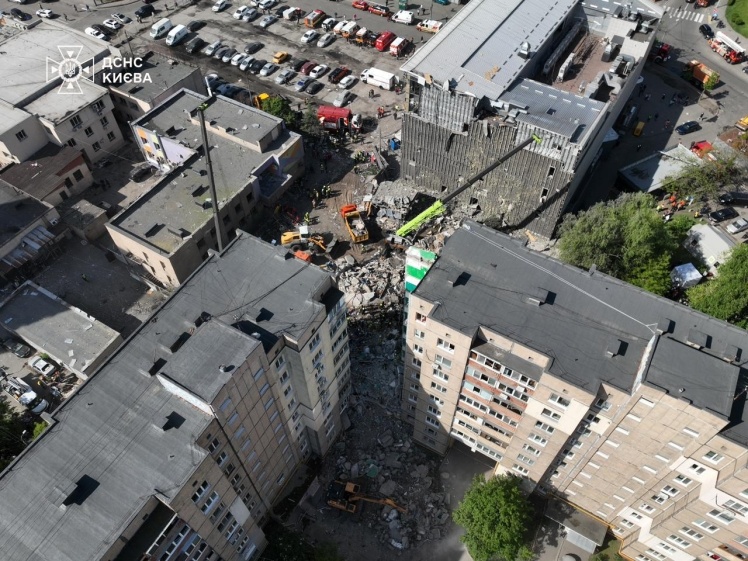
Kyiv was the worst hit, with flights to six districts. In the Darnytsky district, an entire entrance to a high-rise building collapsed after a Russian Kh-101 missile hit it. 24 people died, including three children. Another 48 people were injured.


In total, this week the Russians have launched over 3,170 strike drones, more than 1 300 guided aerial bombs, and 74 missiles of various types, most of them ballistic, into Ukraine. The shelling during the week killed 52 people and injured another 346 people, 22 of them children.
President Volodymyr Zelensky promised a fair response to these attacks.

The largest attack on the Moscow region since the beginning of the war
On the night of May 17, the largest drone attack on Moscow and the Moscow region since the beginning of the Russian-Ukrainian war took place. The operation was carried out by SBU together with other units.
The Moscow Oil Refinery, the “Angstrem” plant, which supplies semiconductors to the Russian military-industrial complex, and the Solnechnogorsk and Volodarsk oil pumping stations were under attack of drones.
In addition, Ukrainian troops attacked a number of Russian military facilities at the Belbek airfield in occupied Crimea and an FSB patrol ship in Dagestan in the Caspian Sea.
"Eurovision-2026"
The final of the Eurovision Song Contest, which took place this year in Vienna, Austria, took place on the evening of May 16. The victory was won by Bulgariaʼs representative Dara with the song "Banagaranga".
Ukraine took ninth place — singer Leléka with the song “Ridnym” scored 221 points from the audience and the jury.
Resignation of the Prime Minister of Latvia
On May 14, Latvian Prime Minister Evika Silinė announced that she was submitting her resignation to the Seimas. This means the resignation of the entire government.
The government had effectively collapsed the day before when the Progressive Party left the government coalition.
The reason for this was that the Prime Minister nominated her military advisor, General Raivis Melnis, to the position of Minister of Defense instead of Andris Spruds.
Spruds resigned last week after Ukrainian drones were shot down over Latvia after being diverted by Russian electronic warfare equipment. Silinja criticized the minister for the slow deployment of anti-drone systems.
The countryʼs government will now continue to act as an interim government until a new one is formed before general elections in October.
Trumpʼs trip to China
The US President Donald Trump, along with a delegation, paid an official visit to China from May 13 to 15 for the first time in 9 years — the last time he was in Beijing was in 2017. There he met with Chinese leader Xi Jinping.
The White House press service reported that during the meeting, the leaders agreed that the Strait of Hormuz should be opened to the passage of ships carrying energy resources.
In addition, Trump said that China would buy oil from the United States and agreed to purchase 200 Boeing aircraft. Trump and Xi also agreed to reduce tariffs on some goods.
Agreement on the establishment of the steering committee of the Special Tribunal for Russiaʼs crimes against Ukraine
On May 15, at a meeting of the Council of Europe, a key decision was made to launch the Special Tribunal for the crime of Russian aggression against Ukraine — an agreement was approved to create a steering committee.
The decision was supported by the EU and 36 countries. The agreement will define how the Special Tribunal will operate and be governed, and will help attract broader international support.
Ukraine insists on the creation of a Special Tribunal, since the International Criminal Court and other similar institutions cannot, at this stage, consider cases concerning the crime of aggression.
For more news and in-depth stories from Ukraine, please follow us on X.