
The National Tax and Customs Administration of Hungary (NAV) reported new "evidence" in the “Oschadbank” case and published a video with Ukrainian collectors.
This is stated in the NAV statement.
The institution claims that in the video, a former major general of the Ukrainian special services (he was in charge of the transportation of money) is allegedly forging documents in the toilet of a gas station. At this time, other collectors, according to the Hungarian side, are discussing "corruption funds".
“Oschadbank” responded to NAVʼs accusations and stated that the video was faked. When it was published, it was subtitled in Hungarian with phrases that the collectors do not say. When one of the collectors says "itʼs obvious what youʼre doing", the subtitles translate his words as "itʼs obvious corrupt money".
The video itself was shot back in 2025 near Vienna. Then, during the trip, the mobile office in the “Oschadbank” car broke down, so the team printed documents in the parking lot. The process of signing these documents was captured on video.
Most likely, the Hungarians found this video on the phone of one of the collectors. The bank emphasized that the phone with the "evidence" was seized illegally, since the owner of the video is a witness in the case.
NAV also stated that the collectorsʼ armored vehicles were transporting money that was not in circulation and that they linked to financial institutions in Poland and Gibraltar. “Oschadbank” responded that transporting money that is new or not in circulation is completely legal.
NAV has sent a request to the Prosecutor Generalʼs Office to obtain a European Investigation Order in Austria and Poland.
Kidnapping of the “Oschadbank” collectors in Hungary
On the night of March 6, “Oschadbank” reported that seven of its collectors had been detained in Hungary. The two collection vehicles contained $40 million, €35 million, and 9 kg of gold. The vehicles were traveling on a regular route between Ukraine and Austria.
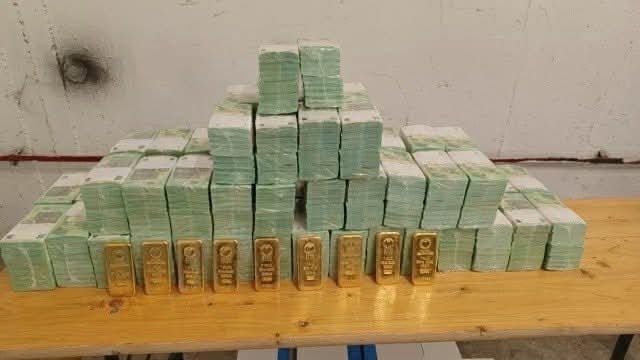
Hungary said it had detained Ukrainian tax collectors on suspicion of money laundering. Meanwhile, Hungarian Foreign Minister Peter Szijjarto, commenting on the situation, said that “the question arises whether this is money from the Ukrainian military mafia”.
“Oschadbank” responded by explaining that since the beginning of the full-scale invasion, all transportation of currency and banking metals has been carried out only by land. “Oschadbank” collection vehicles perform such trips every week and have a license for international transportation from the State Service for Transport Security.
All the collectors detained in Hungary have extensive work experience — from 3 to 21 years. The valuables in the cars belong to a state bank and were transported from Austria to replenish the cash market in Ukraine.
Subsequently, the National Police of Ukraine initiated criminal proceedings into the kidnapping of Ukrainian citizens and their company car.
On the evening of March 6, all seven collectors were deported and returned to Ukraine. The Foreign Ministry said that the men were held in handcuffs and transported blindfolded for 28 hours. One of them felt sick and fainted.
The Guardian, citing sources in Ukrainian law enforcement agencies, wrote that Hungarian anti-terrorist police agents forcibly injected one of the collectors of “Oschadbank”. According to Ukraine, it was a relaxant designed to make a person more talkative during interrogations.
On March 10, the Hungarian government issued a special decree following the seizure of $40 million and €35 million in cash and nine 1-kg gold bars from Szczecin. The countryʼs National Tax and Customs Administration decided to keep them until the investigation is complete.
After the theft of funds and gold and the detention of the collectors, “Oschadbank” suspended the import of currency into Ukraine and began looking for alternative methods of its delivery.
For more news and in-depth stories from Ukraine, please follow us on X.