
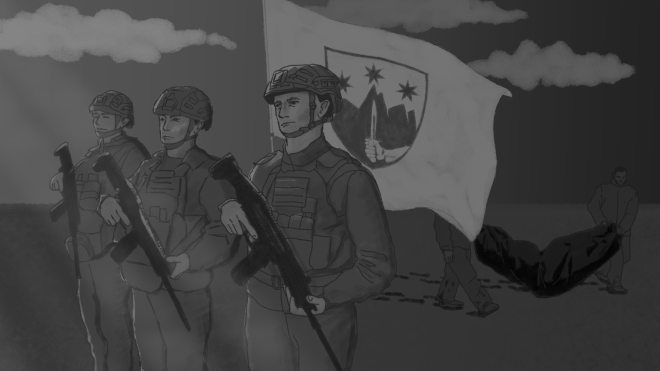
Where "the ordinary become invincible"
The main page of the “Skelya” website features smiling soldiers and the slogan “Ordinary People Become Invincible Here”. The “About the Regiment” section has a short history: “Skelya” began as a volunteer mobile fire group that destroyed Russians from the first days of the full-scale invasion.
The combat path included the hottest spots of the war: Izyum, Soledar, Bakhmut, Avdiivka, Vuhledar, Pokrovsk. The regiment’s commander is Yuriy Harkavy, Hero of Ukraine, full holder of the Order of Bohdan Khmelnytsky, with a call-sign “Skala”. Among the advantages of the regiment described are high-quality training, modern weapons, and decent support. This is partly true.
“The support in the regiment is ʼmind-blowingʼ,” says the first deputy of the Office of the Military Ombudsman Ruslan Tsyhankov. Some of the soldiers we interviewed also praise the regiment.
“I was sick for two weeks, but the military training was really good,” says a soldier from “Skelya” who has dozens of combat missions on his account, on condition of anonymity.
“These are combat instructors, guys who have been in the fighting. They understand what they are talking about.” Ten soldiers from “Skelya” received the title of Hero of Ukraine. Another feature of the unit is that it is large. The regiment does not specify how large it is, they simply say that “as they call it [up to 13 000 people], so it is”. This is all one, positive and quite real side of the unit, but there is another. It starts with the “Сhicken Сoop”.
“Chicken Coop” is the informal name for the “Skelya” distribution point, the first location to which mobilized people are taken. It is a long building on the outskirts of the village, resembling the premises of an abandoned agricultural enterprise.
Inside, it has been converted into an improvised barracks: sheathed with fiberboard, divided into six residential sectors, with a bathroom and an equipped dining room. No windows. There are bunk beds in each sector.
According to eyewitnesses who have passed through “Chicken Coop”, this place simultaneously houses 1 000-1 200 people, many of whom are people with addictions. New recruits are constantly arriving there. Everyone’s mobile phones are taken away even at TRC.
“In short, they brought us there, took us out like out of a prisoner transport van, stripped us naked, went though our pockets, forced us to take off our underwear and do squats,” recalls his first impressions of arriving at the “Chicken Coop” Oleksandr Zhykin.
He got there on February 15, 2026, but not from TRC. He joined the army three years ago. He received a summons, appeared at the call and went to serve at the headquarters of one of the brigades. He was a medic in a medical company and a clerk. He says everything was fine until the commander changed.


Oleksandr Zhykin has served in the army since 2023.
Personal archives of heroes / «Бабель»
Both before and during his service, Oleksandr was on substitution maintenance therapy, a state program for drug addicts. Under the supervision of a narcologist, patients regularly receive special medications, most often methadone, which reduce drug cravings. The doctor sets an individual dosage of the drugs, which allows the patient to lead a stable lifestyle — work, maintain relationships, and be safe for society.
Zhykin says that the new commander took away his methadone because he believed that it should not be in the army. Oleksandr wrote a statement to the police: “He took away my medicine, without which I simply cannot live.”
After that, Zhykin ended up in a reserve battalion. A similar conflict arose there — he was not allowed to leave to get his medication. One day, Oleksandr left the military unit and went to get the pills. When he returned, the next day he was issued a special permit. After that, he ended up in the “chicken coop” of “Skelya”.
The “Chicken Coop” is a temporary place where recruits usually stay for a few days. Then, so-called internal buyers from the “Skelya” battalions arrive there to further take the mobilized ones for basic combined-arms training (BCAT). Some stay there longer: “I stayed there for two days. And there were people who stayed for two months. I even saw some who stayed there and started working,” says Oleksandr Zhykin.
Armed men (or "vertukhai" as another mobilized person who escaped from "Skelya" due to bullying calls them) immediately explain to the recruits in what situation they are now: “First experience of visiting the toilet was ʼpricelessʼ — in groups, under the muzzles of machine guns, ʼsophisticatedʼ insults and rough kicks for not being in a sufficiently even formation or appearance. Endless squats, exercises, the planks, "one and a half" so that they "realize in what situation they are", do not waste time, but prepare for the upcoming "mission". In the toilet, in the dining room — everywhere with an armed escort.
"Like prisoners of war," Zhykin ironically said.
Upon arrival, as those interviewed say, recruits are sorted.
"Drug addicts are put in one direction because they behave inappropriately, and some of them are in a bad condition. If they behave badly, they are severely beaten. Those who are calmer are biding their time," says another mobilized person who was in the regiment.
Many recruits begin to experience drug withdrawal syndrome while still in the "Chicken Coop". In this state, people stop sleeping, feel pain all over their body, nausea, diarrhea, and there is a high risk of suicide. The interviewees say that only a few are given IVs, which somewhat alleviate the condition. Some pf them have hallucinations and delusions — they are isolated.
“I can tell you in detail how I was in solitary confinement with four people with the clanks at the same time,” says one of the mobilized people on condition of anonymity. The man does not have an addiction, he was punished for refusing to squat. For this, he spent two days in solitary confinement.
The solitary confinement is a tiny room, with a double mattress on the floor, which takes up most of the room. Six or seven people were there at the same time. At least four of them were in a state of abstinence.
There were six or seven people in the punishment cell at the same time. At least four of them in a state of abstinence.
Anastasiia Lysytsia / «Babel'»
"And each one was in his own hallucinations. Talking to someone. They [drug addicts] were breaking down doors, rioting. The guards calmed them down — they sprayed tear gas into the cell, and we all breathed it," the soldier recalls.
According to him, people were not taken to the toilet — there was a bottle to piss in the punishment cell. At some point, those who had seen the "cartoons" began to strip naked, jump and pour water on themselves. When the water ran out, a bottle of urine was used. Those who did not have an addiction were also beaten for this.
"One of them then started to freeze, and refused to put on his clothes, and refused to take food. I remember he hid under the blanket and there, under this blanket, he shit himself. There was also masturbation," the interlocutor recalls, overcoming his shame.
A few days later, he and a group of others were rounded up and taken to training. On the way, several people from a nearby bus broke the window and ran away. He recalls that they were caught up and beaten in front of everyone.
After several days in the "Chicken Coop", Oleksandr Zhykin was assigned to the third infantry battalion, despite the fact that the preliminary conclusion of MMC stated that he was unfit for service in the airborne assault troops.
"If it says ʼMINESʼ somewhere, you donʼt have to check it with your foot"
So, a pine forest. In the forest are tent camps a few kilometers from the training ground, where military training takes place. Each tent has bunk beds for a total of 35-40 people. This is how mobilizers who were there this winter describe one of the very first training centers "Skelya" with the most brutal regime.
The regiment does not disclose the exact number of its training bases. In general, in addition to the distributor, Babel counted at least four locations. New ones are also being built. They differ mostly only in that somewhere recruits live in tents, and somewhere in dugouts. According to former mobilizers, the rules are more or less the same everywhere.
The first thing new recruits need to understand is that they are not allowed to move around freely.
“They are even allowed to go to the toilet only when there are enough people (at least five) and only when accompanied by a guard with a machine gun,” says one of the interlocutors, who escaped after a few weeks of being there, on condition of anonymity.
According to him, there are two guards for each tent: if one leads to the toilet, the other stays. It is also not allowed to go out on your own (for example, just to get some air). Recruits always march in formation anywhere. If someone lines up incorrectly, a guard can fire a few bullets into the ground or into the air.
“As they constantly emphasize, all the cartridges in the machine guns are live ammunition, they can easily hit a mobilized person in the legs, and they won’t be held accountable for it. At first, right after that, some people forgot about their desire to go to the toilet, or went without reaching it,” the man says. Oleksandr Zhykin confirms that they didn’t go to the toilet at all at night — the guards told them to defecate in a bottle.
Going the toilet under escort is an exaggeration, says the head of the civil-military cooperation group "Skelya" Andriy Suray to Babel. It was he who we asked questions about everything we heard from the mobilized. This conversation lasted two hours and continued in chatting.
"I havenʼt seen this at any of our training grounds. If a person — for example — has shown himself to be prone to AWOL, then itʼs possible. This is not a common practice, letʼs say," Suray assures. According to him, recruits move freely around the training center. The only exception is when they go long distances — to the shooting ranges or to the dining room.
Interviewed by Babel, the "Skelya" mobilized from various training bases speak not only of the armed convoy, but also of the mined perimeter around the centers. Signs with the words "mines" are hung on the fencing tape around the tents. Some recruits only saw these signs, others heard the explosions and saw their consequences.
A man who stayed in the tent camp for several weeks says that there were explosions almost every night. Animals were often blown up — hares or roe deer — there are a lot of them there. But not only them. He remembers a recruit from Kharkiv, who looked about forty. He looked disoriented and, apparently, resisted the new reality — he spoke little, was withdrawn.
On the night of February 26, 2026, when everyone in the tent was going to bed, a loud explosion was heard on the street sometime after midnight. Then, the witness recalls, screams and another explosion were heard. After that, the guards came in, took everyone out of the tent, lined them up and counted them. One person was missing.
10-15 minutes later, an ATV drove up to the formation at speed. It was driven by the head of the training ground security with a call-sign "Fin". Behind him sat the missing man. It was that Kharkiv man with a bandaged eye. Through his torn trousers, his legs were visible, cut by fragments. One of the guards lifted his shirt — there was a large hematoma on his stomach.
The guards, turning to the ranks, demonstrated what could happen if he ran away — the man lost his eye. Our interlocutor still does not understand how he got out of the tent. He assumes that he found some kind of crack below.
The witness recalls that “Fin” ordered the wounded man to kneel in front of the formation. He did not move. The head of the guard hit him, and the man fell helplessly to the ground. Then “Fin” took out a pistol and fired in the direction of the lying man.
The head of security fired a shot into the ground next to the mobilized person, which exploded nearby.
Anastasiia Lysytsia / «Babel'»
“We were lined up in three columns. Those who stood in the first line and saw that the bullet entered the ground next to the body (not into the person), endured everything more or less normally. Those who, like me, stood in the second or third row, reacted to the show not so calmly. At least my legs definitely bent. They repeated to us once again that there was no point in running away, and they allowed us to go into the tent. We did not see “Isak” [the call-sign of the soldier who was running away] again. However, almost everyone, following the “vertukhais”, repeated that they would not write him off in any case. He would just (unlike us, stormtroopers) spend the rest of his service digging trenches or doing something equally ʼundeservingʼ,” the man says.
A witness recalls that the person who blew himself up was named Oleksandr, and his last name was either Isakov or Isaev. "Skelya" confirmed Babel that Oleksandr Isaev was indeed mobilized. But they voiced a different version: "During training on Feb 26 he deviated from the designated route and blew himself up on an unknown device." They also reported that on March 15 the man died in hospital from pulmonary and heart failure.
Babel found another case of a person blowing himself up at the "Skelya" training center. The man categorically refused to talk to the editorial staff, but a person close to him agreed to speak anonymously and provide some documents. She said that the soldier had been training for less than a month. One day he called and said: "I blew myself up." Wounded man was taken out of the military unit and told to call his relatives to come pick him up.
"I donʼt think he wanted to escape. By and large, they all know that there are mines there. And if there is any quick movement, they shoot him in the back," says our interlocutor.
When the relatives took the man away, he was bleeding. A few days before, they had tried to treat the wounded man in the field. The entire lower part of his body to the waist was affected — the woman counted about 50 fragments, and Babel has the relevant medical document. His legs, abdominal cavity, groin, and urethra were affected. The genital organ suffered the most. Operations, for which he had to sell valuable property, did not help.
“He already tried to get out of the window,” says the interlocutor. Now the man is in a difficult emotional state. According to her, despite this, after some time the unit decided to return the man to its ranks, to the medical company. So now he is hiding. “Skelya” does not abandon its own people,” those who served there often say that. But they put a different meaning into this phrase than the regiment’s media workers.
Oleksandr Zhykin tried to escape from "Skelya" from the very first days. The first place he was taken to was not a training ground, but an old camp in the forest. He says that the territory there was not mined. He escaped with another guy — they took advantage of a way to the toilet. While the armed guard was distracted, they rushed in different directions. He says then they opened fire on them. They shot not in the air, but at their legs. They were running between the trees, so the bullets did not hit them. Drones were raised into the air.
"In short, they found us. They knocked out our teeth, and broke our ribs. And this guard, from whom I ran away, says: ʼDo you want me to go at the frontline instead of you, bitch?ʼ" recalls Oleksandr.
The regiment claims that they first heard about Zhykinʼs beating from Babel. They deny that the escapees are being shot by combat troops. Regarding the mined perimeter, Andriy Suray hesitated for a long time and finally formulated his answer as follows: "If it says ʼMINESʼ somewhere, you donʼt need to check it with your foot."
"They call the boys ʼdisposablesʼ"
Oleksandr Zhykin underwent military training in a barn. He says that after an escape attempt and a beating, he and his “partner” were completely wrapped in duct tape, thrown onto a concrete floor, and placed under guard.
“And for a week we just piss and crap right there. On ourselves. They brought us food, but I didn’t eat or drink much because I knew I would want to go to the toilet.” Sometimes they would come into the barn and beat them — some with their gun-butts, some with their boots. It was a fierce month.
A week later, they were taken to wash and returned to the house. Oleksandr says that on the very first night they ran away again: “We take the blanket down from the second floor. The three of us ran away. Well, thank God, at least the third one ran away. They caught us, beat us again, and threw us tied up in the barn again.”
This time, the escapees stayed there for a day. Oleksandr says then they were taken out, handcuffed to each other, and transported to the training ground.
"For a week we walked everywhere with him holding hands, we were already like celebrities there. We slept on the second tier, strapped to each other. Imagine, you still have to climb up there. Letʼs say, if one wants to go to the dining room and the other doesnʼt, you have to go together. Or to the toilet. And a personal guard with a machine gun was always with us," says Oleksandr.
According to him, a week later they were handcuffed, given shovels, and told to dig toilets and holes. Oleksandr asked to write a report and be transferred: "And for this question, I was beaten again."
Almost all the men who escaped from there talk about “taping” in training centers. At one of the training grounds, as Babel learned, a zone was set aside in the dugout for those who refused to serve due to religious beliefs. Later, people in abstinence began to be placed in them. Three witnesses recall that the especially rebellious were tied with tape.
“They were tied to a pole inside the dugout where they kept us. There are wooden bars there. The dugout was made of wood,” explains one of the witnesses. A person could be tied for a whole day.
Eyewitnesses recall that people with mental disorders were also accommodated in the religious dugout.
“It was obvious that these people needed a psychiatric hospital. We were not allowed to leave this building anywhere, and you can’t explain to these people that you can’t leave. They [the guards] beat them with rifle butts, fists, and kicks, and threw them back at us. A few of our guys tried to help these people,” says one of the “religious” man. Then their dugout began to be locked.
Babel found a person with a mental illness who was mobilized to "Skelya". We talked to the man in the presence of his mother. His problems are obvious to an average person without a medical education. The man pronounces words poorly. How he passed MMC is unclear. But according to his mother, he was not released home by the training center, but by the combat commander.
Before that, he underwent training along with everyone else and received kicks. The editorial office also has anonymous testimony that mobilized people with HIV, tuberculosis and hepatitis “C” were kept in the unit, depriving them of the opportunity to take the necessary medications for life.
One of those mobilized to "Skelya" recounts an overheard conversation between the training ground leadership, which was about the next deployment of recruits: "They are being brought here, get ready. There will be a thousand ʼ200ʼ."
Oleksandr Zhykin has similar memories: "Some chief of staff or someone came up to our tent: ʼWhoʼs here? Oh, the third troop. ʼDisposablesʼ. And he left. Can you imagine what they call the guys? ʼDisposablesʼ. That means that we have only one way [from here]."
One of the active soldiers of "Skelya" witnessed a "zombie apocalypse" during a training exercise, where drug addicts were brought in: people were beaten, some defecated in the ranks. He says it was scary. He also adds that although he himself is not a supporter of such harsh methods of "working" with people, he saw how after training some drug addicts “realize themselves as warriors, and real motivated tigers".
When asked what happened to those who did not become "tigers", he answers briefly — they undergo the same basic combined-arms training, and went out in exactly the same way, but "without knowledge, without skills, without anything".
A person registered with a narcologist can only join the army voluntarily, explains the head of the All-Ukrainian Association of People with Drug Addiction Oleh Dymaretsky. Indeed, there are many soldiers on substitution maintenance therapy (SMT) who make arrangements with commanders, go to receive drugs and return to combat missions.
“I will not talk about everyone, but only in the VOLNA organization there are people who simply stood to their death in the assault units of Kharkiv, Zaporizhzhia. I have 26 people who died for our country, who had SMT and accompanying serious diagnoses, but this is not a reason to grab people and say that they can do it too. No, they can not. These are the few, just exceptions,” says Dymaretsky.
According to VOLNA, there are currently 26 000 people on the state SMT program, 70% of whom are men. If a person has confirmed drug addiction and needs treatment, and especially if they have severe mental disorders, these are all grounds for declaring them unfit for military service.
If the disorders are less severe or episodes in the past, the Military Medical Commission may make a different decision. Most of the mobilized people interviewed by Babel said that they did not actually pass a military medical commission — MMC simply issued them certificates of fitness.
Dymarecki explains those who are on substitution therapy are sick people. They have diagnoses that pose a danger to both themselves and the army. Without therapy, a person experiences torture and can end their life by suicide. But not only that: "After three days in withdrawal syndrome, he can simply be the person who goes over to the enemyʼs side or, even worse, shoots his own people."
“I don’t quite understand when they tell me that I have to continue fighting for years, and the person who receives methadone at my expense should be sent home, but I shouldn’t go to my children,” says the head of the civil-military cooperation group “Skelya” Andriy Suray.
The regiment talks a lot about social justice. Different people fight there: both successful and educated men, and those with colorful biographies — those recruited from prisons and drug addicts. The regiment rightly notes that there are very few people willing to join the army, especially in assault troops, and there is a critical shortage of people. So they work with those who are.
To accusations about drug addicts in the ranks of “Skelya”, Andriy Suray responds as follows: “If MMC found him fit, he IS fit. Who should we believe? A person who evaded his duties for four years or a medical commission?”
Sasha Zhykin did not hide from the army. He served since 2023, and although he is now in AWOL, he plans to continue serving: "I am still ready to serve. We are currently in the process, we have contacted many authorities. We just donʼt know what to do."
The man is ready to serve in support units, medical units and in logistics, security, in the communications unit. Instead, he is hiding from "Skelya".
While Oleksandr was in the regiment, his family was looking for him. When the man was first given a phone, he managed to write and then delete a message that read: "Call the hotline. Every day. At least theyʼll stop beating me. I shit myself."
Photo of Oleksandr Zhykinʼs correspondence with his family.
Personal archives of heroes / «Бабель»
The next time the mobilized person was finally allowed to make a phone call — under supervision in speaker mode. Oleksandr came around to dial on video, but the guard didnʼt notice — Zhykin was on the second tier of the bed.
"Iʼm alive and healthy. Everything is good," Oleksandr said, surreptitiously showing his beaten face to his relatives. They recorded everything.
Traces of beatings on Zhykinʼs face.
Personal archives of heroes / «Бабель»
Oleksandrʼs father wrote a statement to the Military Law Enforcement Service of the Armed Forces of Ukraine, but the document ended up in "Skelya".
"The company officer told me: ʼBitch, you want to fucking lie to everyone here?He calls via video, look at him!ʼ I think theyʼre going to kill me now, and I say: ʼNo, I didnʼt.ʼ He says: ʼI have your photo,ʼ" Oleksandr recalls.
After that, they stopped beating him. True, they forced him to record a message that he was fine.
Zhykin managed to escape from "Skelya" when he was transferred to another location. Coincidentally, to his hometown, which he knew well. He says he was run over by security while going to the store.
Relatives say that the regiment was looking for Oleksandr. They came to his fatherʼs house, questioned him, and waited for several days near his house. They also called his girlfriend from his tablet, which remained in the unit.
"I personally took the boy off the noose”
Oleksandr Semenov, the same man who came to the Kropyvnytskyi hospital all beaten up in January 2026, also did not refuse to serve. According to his mother Svitlana Khrystus, he twice applied for military service himself — in 2022 and 2024: “I personally waited for him at TRC, and gathered his things for him.”
Sasha loved cars, had a knack for fast driving, so he wanted to get involved in the evacuation of the wounded. Semenov was not taken into the army. He was unfit because he was on replacement maintenance therapy. But in 2026, for some reason, MMC recognized him as fit, and on January 10, Semenov was taken to “Skelya”.
And on January 23, he came to the hospital in his native Kropyvnytskyi all beaten up and said the following: “They beat you up, tie you to a quad bike and start dragging you along the ground, until you’re razed.” Sasha escaped from "Skelya" with a group of mobilized soldiers as they were being transported from one training center to another location.
The video, filmed by the hospital doctors, shows that he has several deep wounds on his head, dirty and beaten arms and legs, and a cut on his palms and lower back.
“It was me who filmed him. And then I went to the my office to cry,” the head of the substitution maintenance therapy department Tetyana Hurenko told Babel. Oleksandr is her patient. According to the doctor, 160 people were taken to “Skelya” over the winter. Often they were grabbed right in the hospital corridor.
When Sasha arrived at the hospital beaten, he listed the people who, in his memory, committed suicide there: “Skipa Maksym hung himself with his bulletproof vest. The next one is one whom I personally took him off the noose — the boy climbed into the toilet tank and strangled himself. There were two others: it was at the first shooting range, they each took a bullet and shot themselves in the head there. In short, in four days, nine people committed suicide.”
His words, which remained off-screen, are recounted to Babel by a doctor: “I never thought I could shit myself — so hard they beat me.” In addition to the wounds on his head and the mangled body, witnesses saw broken fingers on his hands and traces of handcuffs on his wrists.
Injuries suffered by Oleksandr Semenov.
Personal archives of heroes / «Бабель»
On February 27, Sasha died in the hospital. The official cause of death was pneumonia. The police did not conduct an investigation.
“I have a military friend who came on rotation in the spring after Sasha’s funeral. He said: ʼWhat are you talking about? We together with “Skelya” broke out of the encirclement together! We made a breakthrough! They are such good guys!’ But not all of them are like that,” recalls Sasha’s mother.
The woman is in a bad emotional state, for her own reasons she refused to tell everything she knows. The only thing she said was: “Each life taken could have been useful in different ways. Someone cleans toilets, someone harvests potatoes, someone drives a car, repairs something, someone kills at least one of those creeps. It’s very painful to lose a child. But it’s one point if they’re sick, or if they’re killed in the war. And it’s quite another point if they’ve been brought to a fatal state — it’s very scary.”
The regiment only informed Babel in writing that Oleksandr Semenov went AWOL during the transfer from the training ground to the medical company. Questions about beatings and tying to ATVs were ignored there.
About the suicides in the "Skelya", which Sasha voiced, they wrote as follows: "The statements about mass suicides were checked by the police, it turned out that these events were collected from all units over six months. The events were documented and appropriately formalized. In most cases, the suicides were instructors, guards and experienced soldiers."
How a recruit who spent two weeks in isolation in the "Skelya" collected events from all units over six months, the editorial office cannot explain.
The suicide of Maksym Skipa, mentioned in the video by Semenov, was confirmed to Babel by the regiment. They reported that no signs of violent death were found in him, "he complained to his comrades that he was feeling bad without drugs".
Babel found a witness who was mobilized together with Maksym Skipa. He says that Maksym was beaten by the “Skelya” servicemen while he was still in the TRC.
“They beat his ribs. His face was blue, purple. They were laughing at him and calling him ʼblue-eyed’. ʼOh, look at him! He crawls, he can’t walk! Blue-eyed’,” the witness recalls their words.
Maksym was beaten because during a search they found hidden methadone on him. According to the witness, this happened at night while they were waiting for other mobilized people in the TRC building. In fact, according to the witness, the “Skelya” servicemen themselves went with the police and detained people on streets.
The witness says that in TRC, they got drunk on cognac and started beating the men. And then they ordered other recruits to “sparr” with the same beaten people.
“I pretended to hit, but I couldn’t really hit! I swung and at the end I lightly touched,” says the interlocutor of “Babel”. According to him, Maksym Skipa continued to be mocked at the training ground: “He could barely walk. We helped him put on and take off his armor, because if he didn’t put it on, they would beat him.” One morning, the recruits woke up and saw that Maksym had hanged himself.
In general, Andriy Suray does not deny that cases of violence in the regiment do occur, but he assures that this is not a system: "Is there such a problem that people who need to perform tasks and achieve the fulfillment of the task from someone who does not want it, use some unstatutory methods? Well, of course, it exists. It is everywhere. Are we fighting it? Yes, of course. That is, no one has ever given anyone such a task [to beat]."
A beating in "Skelya" doesnʼt always require a good reason, says a former instructor with combat experience. He knows of cases when people in rear positions were bullied, because of Starlink malfunctions or errors in paperwork. He says they broke ribs just in front of everyone at a meeting. A military man saw dogs being set on mobilized people. According to him, both the instructors and the training ground guards are bulled [people].
"They [the recruits] are like prisoners. They come out at 6 in the morning, and at 6 in the evening they come in. Thatʼs it. If the instructor comes in and you are sitting, then you will be beaten as fuck," the witness says.
The military ombudsmanʼs office has repeatedly visited the "Skelya" training grounds with inspections. However, it is difficult to identify violations of peopleʼs rights on the spot, because the territory is large.
"Of course, they are trying to form a picture. At the same time, we are still analyzing complaints. And we are working with them," says Ruslan Tsyhankov.
Two of those with whom Babel spoke anonymously said that during inspections, the most beaten or rebellious are taken outside the training center for several days.
“This is such a false front. So many of these journalists came to us. And they [the security] forced us to say how good are we doing here. Itʼs a false front, lies, eye-washing and concentration camps,” says to Babel a person who went through both the training ground and combat training at “Skelya”.
For this reason, Babel refused to go to the regiment’s training center at the invitation of “Skelya”. It is impossible to verify any collected and described facts on the spot, when the unit has the opportunity to choose the place and time of the visit.
"Skelya" is a way to death"
Between late fall 2025 and spring 2026, Babel collected information about 26 deaths among “Skelya” recruits. They were mostly healthy young men with no addictions or serious illnesses.
Most died of pneumonia, but almost all relatives interviewed by the editorial staff or colleagues from other media outlets complain about the lack of timely medical care.
People who died during training at "Skelya" in the last six months
Volodymyr Tsukanov, 32 years old. Joined the regiment on January 15, died in hospital on February 11. Cause of death: pulmonary and cardiac failure. Causes of death: multiple rib fractures, blunt chest trauma.
Dmytro Koval, 50 years old. He joined the regiment on March 6, died in a military car on March 21. The cause of death was cardiomyopathy.
Vitaliy Saltan, 34 years old. He joined the regiment on January 26, died in hospital on February 22. The cause of death was pneumonia.
Oleksandr Semenov, 35 years old. He joined the regiment on January 10, died in the hospital on January 27. The cause of death was pneumonia.
Maksym Skipa, 37 years old. Joined the regiment on January 3, died on January 9 in a military unit. Suicide.
Oleksandr Isaev, 42 years old. He joined the regiment on February 25, died in the hospital on March 15. The cause of death was pulmonary and cardiac failure.
Serhiy Chernoivan, 36 years old. He joined the regiment on December 1, died on December 20. The cause of death was purulent pleuropneumonia.
Serhiy Tabatsky, 38 years old. He joined the regiment on November 3, the estimated date of death is November 25. The cause of death is cardiomyopathy. The body was found in a forest belt outside the military unit.
Vadym Polyvany, 49 years old. He joined the regiment on February 9, died in the hospital on February 27. The cause of death was pneumonia.
Dmytro Shkolyarsky, 34 years old. He joined the regiment on February 10, died in the hospital on February 26. The cause of death was pneumonia.
Serhiy Holubov, 41 years old. He joined the regiment on November 8, died in the hospital on December 7. The cause of death was a cerebral infarction.
Andriy Cherednichenko. He joined the regiment on January 28, died on February 14 in an ambulance. The cause of death was pneumonia.
Oleksandr Kovalenko, 32 years old. He joined the regiment on February 21, died in the hospital on March 24. The cause of death was meningoencephalitis.
Vyacheslav Hekalo, 37 years old. He joined the regiment on February 12, died in the hospital on March 6. The cause of death was pneumonia.
Dmytro Ivanchenko, 42 years old. He joined the regiment on January 6, died in the hospital on February 8. The cause of death was pneumonia.
Roman Kozharko, 45 years old. He joined the regiment on January 10, died on February 14. The cause of death was gangrene of the right lower limb.
Denys Bahriy-Shakhmatov, 38 years old. Joined the regiment on February 1, died on February 13 in a military unit.The cause of death was acute cardiovascular failure.
Vitaliy Karat, 38 years old. He joined the regiment on February 25, died in the hospital on March 14. The cause of death was organ failure.
Vasyl Voychuk, 52 years old. He joined the regiment on March 13, died on March 28 in an ambulance. The cause of death was acute cardiopulmonary failure.
Vasyl Tsyurko, 41 years old. He joined the regiment on February 24, died in the hospital on March 4. The cause of death was acute cardiovascular failure.
Yaroslav Mokriy, 53 years old. He joined the regiment on February 26, died on March 12 in a car on the way to the hospital. The cause of death was chronic obstructive pulmonary disease.
Petro Danyltsiv, 52 years old. He joined the regiment on February 3, died on March 11 on the way to the hospital. The cause was atherosclerotic cardiosclerosis.
Vitaliy Batura, 43 years old. Joined the regiment on February 26, died on February 28. Cause of death: cardiomyopathy.
Ivan Terentyev, 46 years old. Joined the regiment on March 1, died on March 7. Cause of death: cardiomyopathy.
Volodymyr Belas, 47 years old. Joined the regiment on May 21, died on June 9, body found in the forest. Cause of death: pneumonia.
Mortality in the regiment can be divided into two categories: due to disease and due to violence. We will tell you about cases from both categories.
Vitaliy Saltan, 34 years old, Kropyvnytskyi.
His story has already become public. Vitaliy was mobilized to "Skelya" on January 26, and on February 22 he died in the hospital. The mobilized person was brought to the medical facility with a critically low saturation level — 75, where he died a week later. In "Skelya" they say that Saltan entered the hospital on his own feet, what happened next is the responsibility of the doctors.
Andriy Suray believes that the medical support in the unit is good: “In order to check our doctors, we invited doctors of higher status. We had an inspection from the Ground Forces. They did not find any violations of the protocols, regarding the availability of medicines.
Therefore, I trust them. The chief doctor of the Ground Forces said that ʼyour medical service is set up normally’.” However, the Office of the Military Ombudsman states that there are problems with medicine in the unit: “I frankly believe that the medical support was at least at an inadequate level. I state this. We established this in Saltanʼs case,” says Ruslan Tsyhankov.
Vitaliyʼs family believes that he was not provided with timely medical care and is waiting for the results of a second forensic examination, as the man complained of a temperature over forty — treatment in the regiment did not help him. He also talked about the atmosphere at the training, he was scared. He did not even think of running away.
“He told me that they [the escapees] were all flayed, beaten, and maimed. He says it was as if someone had simply tied them to a car and driven them away,” Anastasia Poleva recalls the words of her fiancé Vitaliy.
The couple planned to get married in July of this year. “Every week, no matter what, I go to his cemetery. And what else is there for me to do?” says Nastya.


Vitaliy and Nastya were going to get married in the summer.
Personal archives of heroes / «Бабель»
Dmytro Koval, 50 years old, Volyn.
The man was drafted into the regiment on March 6, and died on the 21st. The cause was unspecified cardiomyopathy. The family does not believe that the death was natural. At the morgue, his wife Lilia did not immediately recognize her husband.
“His face is emaciated, I would even say tortured. His hands are bruised, his legs are bruised, there are bruises on his neck. Additionally, on his face, across almost the entire right side, there is a long stripe — as if he had been hit with his head. On his back is an incomprehensible dent, like a pit,” says Lilia. When the shock passed, the woman recognized her husband by the moles on his face.
The news of Dmytroʼs death was posted in a religious forum — the men who were with him in "Skelya" saw him and went to his relatives. These are the same three people who refused to serve for reasons of faith. They are now in AWOL.
What Dmytro Koval looked like before he got into "Skelya".
Personal archives of heroes / «Бабель»
According to witnesses, Dmytro was silent and frightened, praying for six to seven hours a day and refusing to eat at all. Some of those interviewed assume that the man was fasting. Others say that he was protesting.
“I tell him: ʼBro, listen. There is no need to prove anything to them here.’ Because he started talking about some of his rights. They just silenced him. They beat him, and he shouts: ʼGuys, why are you beating me?’ I look at his face. The man doesn’t understand what’s happening at all,” says one of the eyewitnesses.
From exhaustion and hunger, the man was constantly freezing, so to keep warm he would sleep among the mobilized. Witnesses recall that Dmytro was forcibly given IV drips (supposedly vitamins). To keep him from breaking free, recruits held him down.
Dmytro “draw troubles upon himself” — he demanded that he be released. All three witnesses spent about a week with him, brought him food from the canteen, but he never touched it. For this, he was beaten every day. The man was beaten the hardest when he promised the guards that he would eat, but when he came to the dining room, he refused.
“They hit him on the head a lot. They grabbed him by the neck and threw him, then lifted him up and threw him again. They kicked him, punched him,” says the man, who has repeatedly witnessed the abuse.
Witnesses claim that Dmytro was beaten every day. He was beaten especially severely when he refused to eat in the dining room.
Anastasiia Lysytsia / «Babel'»
All three testify that Dmytro Koval was abused by two medics of the unit with the call-signs "Satan" and "Boks", as well as the head of the training ground "Sych". They say that the head of security did not beat him, but went AWOL.
Babel asked Andriy Suray: when the chief of the training ground beats, is it still an isolated case or is it a systemic problem?
His position is: if it really happened, the guilty should be punished. However, at the moment, the regiment does not have such data, as well as reasons to take measures. And he has no reason to believe people who refused to serve and did not report the beating of law enforcement officers.
The witnesses really did not contact the police. They cannot do so because they are in AWOL. As do almost everyone else who testifies to the crimes in "Skelya".
"This is what they use [against us]," says one of the eyewitnesses to the beatings of Dmytro Koval.
Since Dmytro’s disappearance, Lilia has not had contact with him for over a week. She called everywhere — the “Skelya” hotline, the Ministry of Defense, the Office of the Military Ombudsman. And finally, on March 8, she received an audio message from her husband from an unknown number: “Please pray hard, and get everyone you can involved. Even the police, if necessary.”
The recording shows that the conversation is being monitored. Lilia didnʼt hear anything else from her husband.
Witnesses last saw Dmytro approximately on March 14, then they were separated. What happened to Koval next, they do not know. It is only known that a week later he died in the car of the "Skelya" servicemen. Where they were going and whether he really died in the car, the investigation must establish.
The preliminary examination diagnosed unspecified cardiomyopathy, and there was no mention of signs of violent death. Although there was mention of bruises on the chest, back, ribs, shoulders, armpits, legs, and groin. The expert wrote that these were minor injuries.
Dmytroʼs relatives and friends have sought permission from the court to open criminal proceedings at Dmytroʼs place of residence and conduct a second examination. It is intended to investigate what exactly led to his death.
Dmytro was 50 years old, starting a new life. He met his future wife a few years ago, at a church service. The couple got married, and in 2025 their daughter Nelya was born. The child is now nine months old.
“I don’t want men to be killed so easily. For no reason. I’m not only about Dima, I’m about other men too. People can be useful to society. They can be involved in some other work if he says, ʼI’m not taking up arms,’” says Lilia.


Dmytro Koval is survived by his wife and young daughter.
lryna Vlasiuk / «Бабель»
Volodymyr Tsukanov, 32 years old, Mykolaiv region.
The man was mobilized to "Skelya" on January 15, and on February 11 he died in the hospital. Pulmonary heart failure is the direct cause of death. But what preceded it is important. Forensic medical examination showed blunt chest trauma and multiple rib fractures. Volodymyr stayed in "Skelya" from January 15 to 20. And on January 21, he and 40 other recruits were sent to 1 separate assault regiment.
The police investigating the case believe that the man died from severe beatings on the morning of January 20. And they suspect Junior Sergeant of "Skelya" Anatoliy Kucher of this. In the courtroom, when he was taken into custody, the sergeant himself admitted his guilt. He said that he beat him because he saw that Volodymyr was using drugs. He repented of what he had done, explained that he had miscalculated his strength. And asked to let him serve further.
According to the investigation, Kucher struck Tsukanov three times with his left foot in the chest. After the man fell, he kicked him in the torso and broke nine ribs. The chest injury developed into bilateral purulent pneumonia. With this diagnosis, he was taken to the hospital. He was already taken there from the 1st Separate Assault Regiment.
The investigation has not yet suspected anyone except Junior Sergeant of "Skelya". The suspect himself told Babel a different version through his lawyer.
He says that he did not beat the recruit, but only neutralized him when he grabbed the weapon from the guard: "I just ran up, jumped up and knocked the weapon out of him. And I fell with him. I did not hit him with my fists or my legs."
And his left leg, with which, according to the investigation, he beat Volodymyr, was allegedly hit by an automatic rifle during the incident. He hit him so hard that he was hospitalized and underwent surgery. When asked why he pleaded guilty, Anatoliy replied: "I was confused."
Instead, "Skelya" itself initially denied at all that the suspect in the beating was from their regiment: "We know nothing about the arrested sergeant of ʼSkelyaʼ suspected of his beating. If such a person exists, then he is a sergeant from the 1st Separate Assault Regiment, not ʼSkelyaʼ.”
When the editorial office called the suspectʼs name, the regiment admitted that he really served in them, they told the version about drugs. Let us remind you that in the regiment, recruits are searched, stripping naked. How the deceased could have ended up with drugs is unclear.
Volodymyr Tsukanov was a drug addict. In recent years, his husband had been caring for his paralyzed mother, who died last year. His father followed him. Volodymyrʼs closest person — his sister Alyona — lives far away. Shortly after their parentsʼ deaths, her husband tried to give up drugs again, says Alyona. Therefore, at first, when her brother was mobilized, she even thought it was for the best.
"I didnʼt think I would find him in the morgue."
The woman wants not only to punish the perpetrator of the beating, but also to investigate how her brother was provided with assistance in another unit.
Volodymyr went on video calls with his sister twice. The first time he reported that he had been beaten: “He said that at first he ended up with fat bastards who beat him badly, like they treated a dog, ʼand now I’m with good guys, everything’s fine, don’t worry’.”
The second time he said that they told him that he had broken ribs. She didn’t hear him again.
Volodymyr Tsukanov with his sister Alyona.
Personal archives of heroes / «Бабель»
Vitaliy Karat, 38 years old, Ivano-Frankivsk region.
The man was mobilized on February 25, 2026, and on March 14 he died in the hospital. The cause of death was organ failure. Vitaliyʼs story became resonant after the publication of Suspilne.
And it gained even more publicity due to the statements of "Skelya" that Vitaliy was injured after falling from a pine tree: "Vitaliy Karat tried to commit a suicide while serving. During the search for him, he was found high on a pine tree. After talking, he decided to go down, but fell from it." After his death, like Volodymyr Tsukanov, he was found to have broken ribs and a chest injury.
The regiment assures that they took the recruit to the hospital immediately after he fell.
"We ourselves asked him to have an X-ray because he suspected pneumonia. He was diagnosed with pneumonia and one broken rib. Thatʼs it, period. He didnʼt have a pneumothorax, he didnʼt have bleeding, he didnʼt have a blunt force trauma to the sternum. And the next thing we know about him, he was in the morgue in Dnipro with a dozen broken ribs. He died from bleeding from internal organs and a blunt force trauma to the sternum. Do you understand?" Andriy Suray tells Babel.
Suray does not know what happened to the man in the hospital. According to him, at the training ground no one beat him.
Suray says the regiment is cooperating with law enforcement. Witnesses took polygraphs, an investigative experiment was conducted at the training ground.
Earlier, when representatives of "Skelya" commented on this situation, they talked about two, not one, broken ribs. And also that they have a video that confirms the version with the pine tree. When Babel asked to provide the video, it turned out that there was none, there was a photo of the investigative experiment.
The location of the investigative experiment. At the request of Babel, the regiment provided a photo, claiming that it was the same pine tree.
Personal archives of heroes / «Бабель»
Vitaliyʼs sister Olesya Piskunova claims that before his death, his brother told her personally that he was constantly beaten. And he was sent to the hospital only when he became completely ill.
"They killed him. They abuse everyone very badly. ʼSkelyaʼ is a way to death," the woman says.
"We wonʼt be able to control them on such a scale"
Massive complaints about the “Skelya” began to appear at the end of 2025. And at the beginning of last year, the 425th separate assault battalion was just being scaled up to a regiment.
However, now the “Skelya” is much larger than a regiment. Referring to its large size, they say: the 26 deaths that Babel counted are not many. But this figure is only what the editorial office managed to collect; the regiment does not name its real losses at the training grounds.
And the Office of the Military Ombudsman says: there are more deaths in the regiment. If we compare “Skelya” with other units, the 425th Separate Assault Regiment is also in the lead.
“The percentage of deaths not related to combat operations is proportionally higher in ʼSkelyaʼ. But there is no huge gap. First of all, the issue of medical support plays a role,” says Ruslan Tsyhankov from the Office of the Military Ombudsman.
At the same time, he emphasizes that the General Staff does not have personalized records. That is, military units submit only the number of people there, not names, which makes it difficult to verify the data.
In terms of the number of complaints from servicemen, there are over 9 000 in the Office today, “Skelya” is also in the lead — 5.1% of complaints. But it’s not just about the training centers, but about the regiment as a whole. In second place is 225th Military Training Regiment — 3.1%. This statistic needs to be adjusted for the fact that in other training centers people can get in touch much more often.
"This is the key thing that I keep saying. These numbers are those who were able to reach out, who had the opportunity. Therefore, when we generate statistics, it seems to be approximately the same as everywhere else. But in my head I understand that in reality it is not," says a representative of the Office of the Military Ombudsman.
As a positive example, Ruslan Tsyhankov cites the 210th Separate Assault Regiment, which also conducts its own training — recruits there have contact, albeit not constantly, but daily. After consultations with the Office of the Military Ombudsman, "Skelya" provided the mobilized with the opportunity to contact three times a week.
Separately, the Office also talks about the actions of MMC, which recognize people with SPT as suitable for assault troops: "Such people are illegally in the Armed Forces of Ukraine. And I believe that at this particular moment we must put an end to it. They must be released," says Tsyhankov.
The First Deputy Military Ombudsman Ruslan Tsyhankov.
lryna Vlasiuk / «Бабель»
The Office became aware of the facts of violence in "Skelya" a year ago. Then Olha Reshetylova almost forcibly took away the beaten people.
"I think the command [of the regiment] should have at least been aware of what was happening. If the command is not aware, then this is bad command," she said recently in an interview with Suspilne. She says the scandal then reached the commander-in-chief and the president, and since then the regiment has begun to cooperate.
"We know that within our regiment, the commander does everything to prevent these negative stories from happening. If they appear, they donʼt report them to the commander, they try to hide it, it gets out through journalists or to Reshetylova. The commanderʼs position is to figure it out, if they are guilty, punish them severely. Itʼs really infuriating when we try to make a normal working unit, but because of certain moments we have such a bad reputation," says the regimentʼs spokesman, a former journalist Oleksiy Bratushchak.
The regiment is obviously concerned about its reputation. More and more public figures have been visiting it recently, and “Skelya” is in prompt communication with both the media and the Office of the Military Ombudsman.
Ruslan Tsyhankov says that when the regiment receives a signal from them about a problem, it reacts instantly, but all this happens in manual mode: “They simply chose this tactic for themselves: where we got uncovered, we will fix everything now, but this is not about systematization.”
According to Tsyhankov, the regiment is too large and does not have a corresponding body capable of managing such a scale.
In June of this year, the Commander-in-Chief of the Armed Forces of Ukraine reported that eight military units had lost the right to independently conduct basic training for military personnel. The logic was as follows: not only the training program is important, but also the attitude of commanders to their subordinates.
“Where commanders take care of their subordinates, improve living conditions, develop the training base, where instructors accompany recruits and maintain constant feedback, there is a higher quality of training and fewer cases of unauthorized abandonment of units,” said Oleksandr Syrsky.
“Skelya” was not included in the list of those who lost the right to conduct their own training.
“There are many worthy officers there. And while there is hate on ʼSkelyaʼ on social networks — very often itʼs deserved — these people in nine directions are performing very difficult tasks today. It’s true,” says the head of the Military Ombudsman’s Office Olha Reshetylova.
In her opinion, the commander-in-chiefʼs idea to create assault units is correct, they perform critically important tasks: "The only question is that we simply wonʼt be able to control them on such a scale, especially if we create a separate branch of the troops. The military ombudsmanʼs office there will definitely not be enough. We live there anyway, in the assault regiments."
Reshetylova believes that such units should be created in each corps so that the corps commander can monitor what is happening there and be responsible for it.